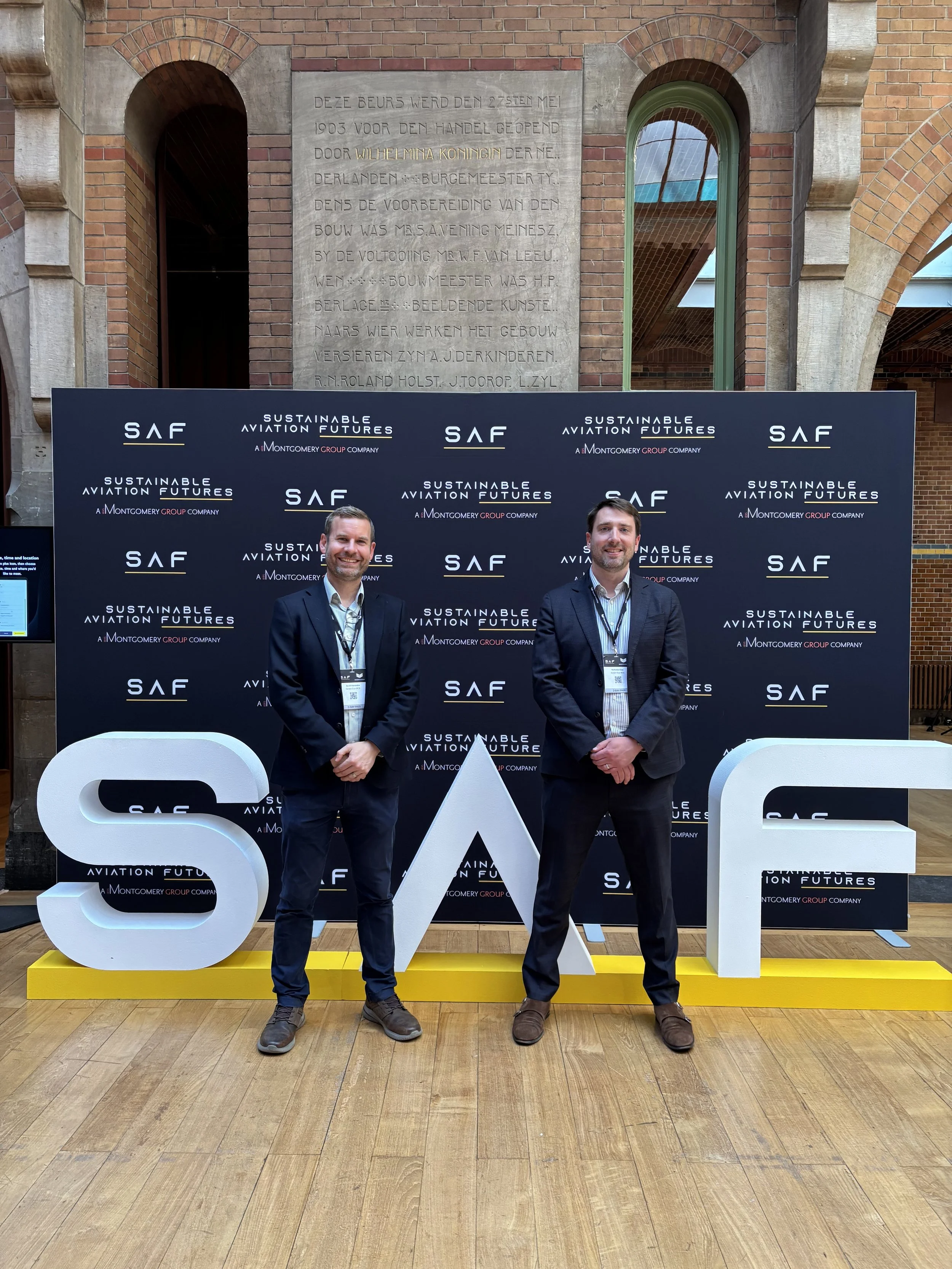
SAF Congress 2026: Amsterdam
Scott Koronka and Nicholas Clay joined industry leaders at Sustainable Aviation Futures Congress to discuss the latest developments in SAF, aviation decarbonization, and the technologies shaping the future of air transport.
Their takeaways included:
DAY 1
SAF policy and mandates are clear – the doubts and rumours about delays are unhelpful.
Market has recently mis-priced risk (we've seen that in Hormuz) but in the case of SAF it is also mis-pricing opportunity.
Debate around the pros and cons of a book and claim system for SAF credits. The price levelisation that would result could act as a disincentive.
eSAF scale-up – small number of large plants? Or large number of small plants?
Consistent continued dialogue around: minimising technology risk; importance of long-term product offtake contracts; collaboration; joined up consistent policy.
Courageous penguins versus hibernating bears! (Analogy used to describe different approach of some key stakeholders.)
DAY 2
In response to recent geopolitical crisis, energy security is becoming an increasingly important pillar driving SAF development alongside carbon reduction.
This is not just a European factor. Asia Pacific and South America are embracing this trend with increased SAF capacity and domestic demand – with competitive Chinese eSAF on the horizon.
The HEFA rollout has been a success story, but European advanced SAF and eSAF FIDs continue to wait for pricing support from mechanisms such as the UK’s Revenue Certainty Mechanism and the EU’s intended double-sided auctions.
Collaboration is key. The industry is seeing increasing alliances between technology providers, airlines, and funds to reduce risk and improve project viability.
Finally, the voluntary market and book and claim aren’t just helping traditional corporates, but also helping British Cycling add sustainability to its high-performance culture.
Key question leaving the conference: can Europe balance the energy security ambition against the need to meet mandate goals? And how can regulators help domestic supply become more cost-competitive?
Big thank you to Sustainable Aviation Futures for hosting another great event!